KU Leuven is pleased to invite submissions for the conference ‘TransLATINg the Bible: the Creation, Transmission, and Reception of the Latin Bible’, which will be held on 7–9 April 2027.
The text of KU Leuven’s call for papers follows below:
We welcome proposals for 30-minute papers (including discussion) engaging with the conference theme and methodological approaches outlined below.
The impact of the Latin Bible on the Western world is difficult to overstate. For centuries, its phrases, narratives, and rhythms have served as the bedrock for art, culture, literature, theology, and philosophy. From the intricate illuminations of medieval codices to the intellectual frameworks of the Reformation, the Latin Bible has shaped not only what people believe but what people think, how they act, and create. Moreover, the Latin biblical tradition remains central to modern textual criticism, informing the reconstruction of other versions—most notably the Greek New Testament. As is only appropriate for a textual tradition of such a legacy and importance, the study of Latin biblical texts has recently seen a renewed surge of systematic research into translation technique, manuscript transmission, and the complex reception of Latin biblical texts. To support and stimulate this growing momentum, we are pleased to announce the conference “TransLATINg the Bible.”
The primary goal of this conference is to further consolidate the field of Latin Bible Studies. We aim to provide a dedicated forum for researchers to present new findings and to foster a community centered around the shared corpus of the Latin Bible. By bringing together specialists from diverse disciplines—including philology, linguistics, history, theology, translation studies, book history, and digital humanities—we endeavor to cross-pollinate methodological approaches and build new bridges within the field. Furthermore, this conference aims to combine research on the Old Testament and New Testament, which are often studied separately, to foster new collaborations and create a cross-disciplinary environment.
We welcome proposals for 30-minute papers on any aspect of the Latin Bible, from both the Old and New Testaments. Contributions may address the entire chronological and textual breadth of the tradition, from the earliest Vetus Latina witnesses to the many Vulgate revisions of the medieval and early modern periods. Submissions should include a title and an abstract of no more than 200 words to be sent to the conference organizers Anna Persig and Martijn Jaspers by 1 October 2026. Conference languages are English, French, or German. Proposals in other languages may be considered upon consultation with the organizers. Notification of acceptance will be sent in early November 2026. Presenters are expected to cover their own travel and accommodation expenses.
Topics of interest include, but are not limited to:
For questions regarding submissions or participation, please contact:
Dr. Anna Persig
Dr. Martijn Jaspers
We look forward to receiving your submissions and welcoming you to the conference ‘TransLATINg the Bible’.
Best wishes,
Dr. Anna Persig
Dr. Martijn Jaspers
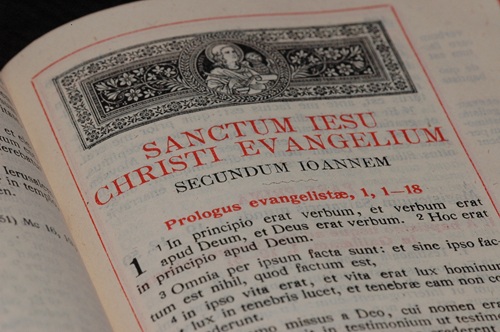
Visual: Wikimedia, Prologus Ioanni – Vulgata Clementina